Monday, November 19, 2012

Lincoln: Anatomy of a Rottentomatoes Capsule


"Daniel Day-Lewis characteristically delivers in this witty, dignified portrait that immerses the audience in its world and entertains even as it informs."

- Rottentomatoes.com's summation of the 90% positive critical response to Lincoln

a) "Daniel Day-Lewis characteristically delivers"

Oh, yes. Coming in as a shocker to absolutely no one, DDL knocks another one out of the park. What's that "one" exactly? Over a dozen weighty, metaphorical monologues, most of which are underscored by a typical John Williams orchestra wank in order to remind us to be moved or stimulated or wryly entertained. He's the smartest, saintliest man in every room he enters, which ultimately grows weary because we already know he's right and we already know that the 13th Amendment will be ratified. It's like trying to convince an audience that Hitler was evil. Lincoln's hollow racial motives are handwaved away via one conversation with a tearful black maid, and what few personal demons we are privy to are teased out by - surprise! - his wife. Using a woman to peer into the troubles of a venerable public figure feels cheap and common. And sure, Lincoln was a great man, but Amelia Earhart was a great woman and that didn't stop critics from crashing that plane. That film had its problems, but it's not like Lincoln doesn't either. Biographical sanctification, long decried as a major flaw for any biopic, is apparently excusable here through the efforts of DDL alone. He's great. Of course. But the Lincoln he portrays is shallow, made to sound deep through densely worded politicking and a surfeit of three-minute tangents (also given an attempted handwave by a character attempting to make Lincoln sound like he isn't the best storyteller in the world). The entire movie is a gift from him to Spielberg, a two-point-five hour long Oscar reel for a man that hardly needs it.

b) "in this witty, dignified portrait"

Counterpoint to "witty": how about babbling? Again, the movie is so enamored with its own wordiness that anything that could be remotely construed as wit becomes agonizingly protracted. Not that I expect Tony Kushner, an awfully long way from Angels in America, to Sorkinize 1865 political parlance, but every single scene and dialogue has the same rhythm: slooooow. The only change from line to line is volume, because even with the linguistic evolutions that have transpired over the last century and a half, people still used to shout when they got angry.

Counterpoint to "dignified": any scene with James Spader's woeful political buttonpusher W.N. Bilbo. The movie's most gruesome scene, involving a wheelbarrow full of limbs, paired with its refusal to show the assassination of the president under the insinuation of "dignity." The very idea that a film that contains at least half an hour of gale force monologuing has any grasp of the kind of restraint necessary for aforementioned "dignity".

c) "that immerses the audience in its world"

The movie looks beautiful; top shelf Janusz Kaminski, reverently lighting and shooting the film like a collection of Old Hollywood portraits. That's basically where my praise for the movie ends. Immersion is awfully difficult to reach when the only noteworthy characters you've got to guide you through this Congressional marshland are DDL, a serviceable Tommy Lee Jones, Sally Field doing a pretty unremarkable Long-Suffering Wife, and about five useless minutes of Joseph Gordon-Levitt. This movie doesn't skimp on its casting, with a gallery of fresh and familiar faces alike, but it suffers a similar fate to last year's Tinker Tailor Soldier Spy in that nearly all of these faces are used to push a point of view or political stance rather than do anything vaguely human. They are not, nor does the movie ever even pretend to care that they should be, people. The only differentiation between a majority of this movie's hugely overstuffed cast is what kind of Muppet they look like. Forget any hopes for a notable African-American presence in the film, by the way: their sole purpose is to remind us, by standing in silent solidarity while their light-skinned oppressors propel all the action forward, that this was a very good thing to happen for black people.

d) "and entertains even as it informs."

Ugh, but only in the most insulting way possible. Spielberg wants us to remember that history can be fun too! So what better way than to break the flow of a movie that's already excruciatingly long and boring by inserting scenes where James Spader is really wacky? Did you guys know that people said fuck back then? Did you know that they made jokes about poop? They really are just like us! There hasn't been such an ill-conceived marriage of drama and comedy since...well, Cloud Atlas. Call this the year of ponderous, overreaching bullshit.

D

Sunday, November 11, 2012

Skyfall: The Bond Brand

Skyfall is a good, solid Bond movie. Not without its problems, if you choose to disregard the predictably hyperbolic BOND IS BACKers: the third act is a pretty thorough wash, squandering a handful of intriguing ideas laid out by the first two; not every action scene lands; and the normally reliable Naomie Harris is terrible in ways that bode ill for future films in the franchise. For the most part, though, the movie is an exciting, beautifully shot, intuitively paced entry in the canon, an effort that buries the forgettable Quantum of Solace and restores its flagbearer to nearly full vitality.

What caught my attention, however, was Skyfall's frequent self-reference and its acknowledgement of Bond as an indelible cultural standing stone. The film is peppered with inside jokes, many of which I'm sure I didn't catch because of my lack of comprehensive Bond knowledge; it also focuses on the perceived obsolescence of England's beloved old guard, Bond and M, and how there's no room for their clandestine methods in a world "without shadows." Bond may be Bond, sure, but is Bond enough these days? Can the world still rely on this aging, lecherous old boozehound? The answer is yes, of course, but the film constructs itself around the incomprehensible possibility that it can't. Skyfall is obsessed with its roots and using them to entertain, raise thematic questions, and perhaps redundantly in the face of its 50th anniversary, celebrate itself.

But does it earn that right? Preying on nostalgia is dangerous, and though it typically pays out considerable financial and popular dividends, it can also make the work in question seem opportunistic or manipulative. This has become an exceptionally popular tactic in the last decade, with remakes and reboots and reimaginings galore. What makes Skyfall's frequent callbacks to its lineage problematic, however, is that the Bond franchise has been transformed so radically in those 50 years that Craig's recent iterations hardly feel like Bonds at all. Sure, there's goofy humor and intermittent camp to be found, most of which is provided by Javier Bardem's hilarious turn as a bottle-blond M-hating ponce with some icky secrets. Skyfall is careful to parcel these Silly Scenes separately from its Serious Scenes, and a majority of the film gives way to a granite Bond deftly maneuvering through action setpieces of desperate urgency. Certainly a far cry from the likes of the Connery Bond films, where he would rarely even take cover during firefights, or especially the iconic-in-a-bad-way intro to Thunderball where he flies away on a jetpack George Jetson-style. Somewhere along the way, probably after Die Another Day came out and was pilloried by the public, some suit at MGM realized that Bond was going to have to start pulling his weight in order to justify his blockbuster status. No more of this hokey claptrap, unless the script specifically calls for a calculably groan-worthy pun or some "witty" "banter." (Side eye to Harris.)

Overriding any concerns of tone, however, is that Bond has always been a commercial icon. Universal consistency be damned: the Broccolis, MGM, and their superspy lovechild have always answered to the dollar before all else, reaching waaaaay back to those conspicuous crates of Red Stripe in Dr. No. These movies have never been shy about embracing shiny, shiny capitalism, what with the cool brand-name cars and the increasing prevalence of recognizable corporate logos on fancy gadgets. Skyfall itself features plugs for Heineken, Omega Watches, a whole bunch of Sony shit, a resuscitation of the classic Aston Martin, a theme song by ostensibly the year's most popular singer, and a bevy of other goodies for us to subconsciously assimilate. Though Phil Rosenthal's "Forming a Bond with Brands" does a good job at delineating the science of restrained yet overt product placement, it misses the rather obvious fact that commercial restraint is not really necessary in a film franchise twenty-three entries strong. The supposed evils of product placement should hardly be a concern when the franchise's most lucrative product is, has been, and always will be Bond himself. So long as his name remains, these films can be changed and warped beyond familiarity, fluctuate in quality, fellate themselves shamelessly, shovel in wares from every gadget-peddler in the world, and people will still go to see them in droves. The Bond brand is unstoppable. Everything else should feel lucky to share the screen with him.

B (is for Bond)

Friday, October 26, 2012

66 Things I Hate About Cloud Atlas


It is as it says.

MAJOR SPOILERS. 

1) Cloud Atlas is a crushing 164 minutes long. I have absolutely no problem with long movies, but this is the cruelty that makes these other sixty-five abuses of the cinematic form possible. If you're going to bind your audience to their seats for nearly three hours, you'd better at least have something of substance to sustain that kind of runtime.

2) So what does Cloud Atlas attempt in this generous frame, exactly? Everything. It's less a movie and more a shameless, pearl-clutching missive on the ills of the world. There is a desperate lack of focus to its sociological ranting - the class system, "natural order," human bondage, identity and cloning, race, homophobia, nuclear power, capitalism, greed both private and corporate. It never ends. And that doesn't even include the porridge of grander philosophical concepts bubbling under all this...

3)...reincarnation, predestination, the infinite rippling of causality, the existence of a soul, religion and belief. On their own, all of these things are interesting, which is why movies are made about them. When they're all crammed together, dispersed over six different narratives, and then delivered with all the grace and subtlety you'd come to expect from the folks who made The Matrix, it turns into a giant, unwieldy, overstuffed sack of hot nonsense. 

Thursday, October 25, 2012

The 2012 Horror Digest, Part 3: Twixts and Turns

The Tall Man


(Why does it feel like half of the pictures I select for this feature are people lying down and looking upset?)

You can catch this one on Netflix Instant, and it's quite the strange movie (if not often troubled), so I would recommend it.

The Tall Man is the most recent of Jessica Biel's many, many, many feints at serious acting, and to her credit, she is very good in it. The role is a challenging and unhinged one, and a committed performance is required for the film's insane plot to actually work. She doesn't fail director Pascal Laugier, best known for the absolutely fucked-up Martyrs, but his continued commitment to the horror genre does. The Tall Man has a complex, unpredictable plot, which makes for a pretty delightful first hour. Unfortunately, certain efforts must be made to keep the film planted in the realm of horror, which means preserving its titular "tall man" conceit and thus obscuring important details until much later in the story. Events unwind in a very confusing fashion, and though it did keep me guessing, eventually all the guessing led to frustration. The mysteries just weren't paying off with enough frequency or quality to justify all of the narrative face-heel turns. As the movie finally morphs from a kidnapping horror film into a social polemic, any sense of rhythm or clarity is lost, and you're left with little more than an awesomely feverish Biel monologue and a really pretentious ending. It crumbles under its own weight pretty spectacularly, but it is unique and impressive in its own strange ways. C+

Twixt


Why are Japanese movie posters always so awesome? I don't know what it is. Maybe I'm just a sucker for pink fonts and girls looking wistful. Anyway, I used this image because a) the poster is cool and b) the movie is visually a complete piece of dogshit, which is horrifying because FRANCIS FORD FUCKING COPPOLA directed it. You know, the guy responsible for a few Godfathers. Apocalypse Now. Dracula, if you're into the whole "style over substance" dealio. But one must remember that Coppola's done some serious garbage, and he's hit an especially awful slump lately, of which Twixt is the absolute nadir. The man seems to have forgotten everything he's ever known about lighting, framing, editing, and cinematography in general. Shot on dirt-cheap digital near Coppola's house, the movie looks about six million dollars shabbier than its $7 million budget, almost to the point of unwatchability. If that doesn't kill it enough for you, please also note: the atrocious acting, led by an obese ponytailed frog that bears a suspicious similarity to Val Kilmer; the senseless editing; the complete lack of scares; the lousy goofy plot, limned with a dash of autobiographical detail that's somehow meant to justify all the cheeky self-reflexivity; and an ending that renders the whole bloody affair a wash. Occasionally the movie actually looks kind of cool in still shot, and you remember why Coppola became successful in the first place, but it left me wondering why he didn't just make a graphic novel out of his dream-inspired ideas and call it quits. This is just an embarrassment, a further sullying of an already questionable auteurial empire. D

Silent House


Cheers to Elizabeth Olsen, whose meteoric rise to critical fawning is entirely deserved. Getting all of this right in "one take," which is actually anywhere between three and seven takes poorly disguised as one, surely took an enormous amount of focus. Even aside from the fact that she pulls off a fairly lofty technical feat, she's also excellent in her own right, expertly conveying delirious fear. Shame about what she's stranded in. The setting, which we're led to believe is important because it's the name of the fucking movie, is treated like dirt by Silent House's all-in-one-shot concept. An intuitive sense of space is never established, which undoes the movie on a plethora of levels. The scares are sluggish because the camera, without the benefit of editing, rarely moves quickly enough to capture a sense of energy, and Olsen often finds herself moving awkwardly to accommodate the cameraman, like closing the door slowly enough to let him in even though she's being chased. Olsen's performance is also threatened by both her costars, who are uniformly amateurish and clearly uncomfortable, and the ridiculous ending, where even her unerring commitment wobbles a little bit. There's a great deal of compositional accomplishment to be admired here, but it's ultimately a gimmick and it doesn't work and that buries Silent House right out of the gate. C-

Killer Joe


Okay, this isn't a horror movie, but it's liable to make you feel more nauseated than anything else on this list. William Friedkin has a gift for tactical provocation, which he brings out in rare form in Killer Joe. A trailer park Greek tragedy, no man, woman or child escapes Matthew McConaughey's dark grasp unscathed. The film is a torrid NC-17 trip into a family conspiring to kill their estranged mother for her $50,000 insurance premium, all with the help of crooked cop Joe Cooper, and naturally things don't go exactly as planned. It plays out like a morbidly violent, sexual Coen Brothers film, although it trades in their dry ingenuity for a dollop of unashamed trashiness. Killer Joe is a heap of raunchy trash given shape by both an expert filmmaker, whose lensing is thoughtful and gritty, and his universally stellar cast. This makes a hell of a one-two punch for McConaughey, who exploits a sort of warped charisma that we saw only in small doses in Magic Mike but which he plays to the nasty hilt here; Juno Temple, playing opposite him, is also hypnotically good as a sort of spaced-out Lolita. There are certain suggestions of seriousness here, a department where the film doesn't particularly excel; it's at its best when it's reveling in gnarly grodiness, rather than affecting depth with cryptic conversations. Too much joy, though, and the film would have pushed too far across the already dizzyingly thin line between exploitation and pitch-black humor. It's a tough watch, but worth it to watch an actor of disposable beefcake status like McConaughey plumb through some seriously dark material. B

Tuesday, October 9, 2012

I've Fallen and I Can't Wake Up: Daymare Town 3


Every year, when summer turns to fall and the weather gets cloudier, I set aside a few hours for myself and run through Daymare Town 3. I can't remember how or where I learned of it (as is common with these apocryphal little Flash games), only that I found it at some obscene hour of the night and played it until I couldn't keep my eyes open anymore.

It's the sort of game that lends itself to obsessive, almost hypnotic play. Your objective seems straightforward enough: you've crash-landed your hot air balloon in a surreal village and need to escape. But the game is shot through with the logic of its titular daymare. Characters speak cryptically and issue indecipherable demands. There's a slew of items, many useless, most bizarre. Puzzles have elements that make sense on a pragmatic basis, but cohere in especially unusual ways. One notable example: feeding the captain of the guard a sleeping pill in order to steal his hat and fool his lackeys into letting you through a gate. Sure, but why did he accept medication from a stranger so readily, and why would you have known to steal the hat, and why are his guards stupid enough to forget what their superior looks like? Convoluted causal dynamics are no new thing to pixel-hunting adventure games, but only in this daymare do they feel acceptable, even organic. The puzzles never feel like cheats, but merely require some unconventional thinking, which leaves the solutions enormously satisfying. There's also a handful of achievements to unlock, and a unintuitive economic system, but they both feel like window dressing thrown in to disguise the game's true roots.

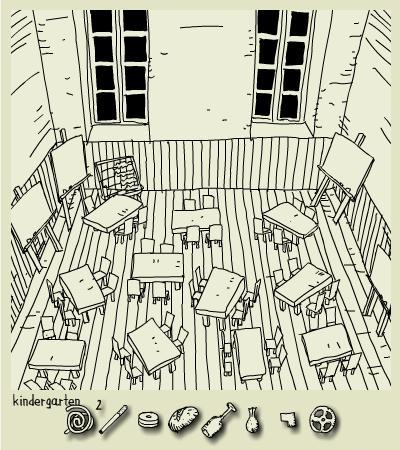
The mechanics and design of Daymare Town 3's gameplay work in exceptional tandem with its aesthetic. Daymare Town is ripe with heavily stylized Expressionist angles, rendering the interiors impossible and menacing. A kindergarten seems a hundred feet tall, and one ray of light illuminates next to none of a pitch-dark basement. Most of the lines are uneven, drawn freehand and with little regard to symmetry - every building looks off-kilter, groaning at its foundations. Music is almost entirely piano, with muted percussion thrown in on a couple of tracks, and a vast majority of the time you spend in the town is soundtracked by howling wind. Sound effects can be slightly jarring, notably the low electronic tones that sound every time you pick up an item or move from location to location. The game gives you the option to turn them off, which I would recommend. Daymare Town 3 lives and dies by its composition; without its schizoid images and minimal, minor-key sound, most of its impact would dissipate. The Submachine games, which strive for a similar atmosphere but fail to reach it because of undistinguished, unfocused art, are good examples of this.

This is not to marginalize the writing of the game. Mateusz Skutnik is careful to paint Daymare Town as an unusual place, but not aggressively so. Much of the quirk in the game is subtle, and the game approaches a wide variety of tones: humorous, sinister, ominous, even a bit melancholy. There's an undercurrent of dry wit to Skutnik's presentation, between locations (a populous graveyard is called a "memorial park"), items (a catheter bag becomes "some liquid"), and dialogue (The Nurse: "Do not try anything stupid. I will put you down."). If this slightly daffy composure appears to stand at odds with the game's more human moments, like when you return an old widow's baby to her, they actually come together with surprising grace. All of these voices are reasonably accommodated by a world so foreign that the player is not entirely sure how to feel while exploring it. 


Daymare Town 3, customary of its medium, is fairly slight. If you're not a naughty cheater you'll probably finish your first play in about five hours. There's a pronounced mystery about it, however, that has kept me compelled even during my third trip through the village. Every consecutive replay feels fresh, rewarding, intriguing. With each new session, I find myself surprised by how few of the puzzles I remember, or how eerie the music actually is, or the double entendre tucked into a line of dialogue that once seemed like a toss-off. The details melt away over the course of a year, which is a quality to any linear adventure game's credit, but the feelings linger.

B+


Sunday, October 7, 2012

The 2012 Horror Digest, Part 2: Whatchoo Know About the Ladies?


V/H/S

For those unfamiliar with this odd little bauble of a horror film, V/H/S is a horror anthology shot entirely through lo-fi recording devices: handheld cameras, miniature cameras stuffed into inconspicuous places, webcams, and the like. If this sounds exhausting to you, it occasionally can be, and I must admit that the last half hour or so felt to me like the longest, most hellish Skype session in the world. Also disappointing is the movie's terrible treatment of women, each one of whom becomes a slut, an idiot, a depraved murderess, or all three. If you can hurdle past these admittedly damning issues in ideology and construction, however, there's a lot of V/H/S that actually works really well. The cryptic, muddled nature of the visuals often makes what's happening on screen indecipherable and, in pairing with the strong sound mixing, quite frightening. Terrible things are constantly lurking where these obsolete, low-end cameras just can't seem to capture them, and that spirit of suggestion is deceptively powerful. Most of these stories, each assembled by a different director, are pretty compelling, and despite a tendency for them to end with resolutions as unsurprising as "and then the evil killed them," they held my attention consistently (short of a couple of dogs). Recommended with hesitations; it leaves a bad aftertaste. B-


The Woman in Black

There's a really excellent period in the middle of The Woman in Black where Daniel Radcliffe, staying the night in a spooky house while examining some sort of important legal document, is besieged by a series of supernatural occurrences. The scene takes place over the course of about five minutes, but in almost complete silence - no music, no dialogue, just the creaking of the house and whatever cackling apparitions fall upon him. Five minutes doesn't sound particularly impressive, but the scene's impressive momentum packs more horror content into those five minutes than probably any other period in the movie. I have long loved haunted house movies like a child, and that's probably why I stuck with this otherwise fairly cut-and-dried genre effort as long as I did. It's not that the movie is bad at all, but there's very little here to get excited about. Radcliffe offers little as a sad lawyer-dad with mutton chops, the plot came from The Innocents' fifty-year-old ghost matron afterbirth, and a majority of the scares are admirable for their reservation but typically fall flat. Nothing here is offensive or incompetent, but in an almost totally undistinguished Gothic horror, it might have given me something to talk about if there was. C+


The Loved Ones

Australian horror is a blip of a subgenre, but one that I feel deserves more attention. My experience with it, admittedly minimal, extends to the harrowing Wolf Creek, the mournful yet potent Lake Mungo, and this bizarre little teen movie. (Also Black Water, but the less said about that bullshit the better.) The Loved Ones is at once a dysfunctional family story, a teen film replete with rejection and angst, and a nasty, inventive horror/torture film with some really fun campy acting. The film embraces both its brutality and its slight goofiness, creating a satisfying middle ground where it's both in on the joke and taking it to unexpected places that make you feel a bit uncomfortable. The music and its uses thereof are especially interesting - music in teenage-centric films is often underutilized or ignored as an expressive tool, but The Loved Ones employs it exceptionally well. The only real problem here is that the ending is bunk, an unfortunately predictable note that doesn't offer anything particularly new or insightful to the film. Kudos for showing the restraint to not write an over-the-top twist ending, but a little bit more would have gone a long way, you know? B


Mother's Day

This is nasty schlock, the sort of controlled and quietly self-aware dumbness that I feel the overwhelming need for every once in a while. I can't really claim this as anything other than a gratuitous, violent, kind of shitty "and then there were none" body count flick, but the execution and cast are committed and the gore is great. It runs for nearly two hours, which is absolutely unnecessary and by far the biggest problem with the movie; you could trim twenty minutes off easily when you take the redundancy of certain scenes into account. Pitting two friends against each other in a duel to the death is intense, sure, but definitely loses a lot of the punch the second time you see it. Kind of diminishes the creativity of the villains, you know? Not that they have much: three of the main baddies are brainless lackeys, barking like dogs and flexing ruthless authority without the aid of the titular Mother herself, played to the hilt by Rebecca de Mornay. She's MIA for the first half hour of the movie, and upon her arrival, it changes from a conventional prisoners-in-their-own-home horror story to a psychological, neurotic, gendered power game. The sexist implications of the monster mom trope are present and arguable, but Mother's Day at least attempts to say something interesting about them. Whether or not it succeeds, though, is ultimately auxiliary to the trope's role as a conduit for carnage. And carnage there is. B


The Hole

Joe Dante has been making odd, fun, mostly youth-oriented films for the better part of three decades now, but nearly all of his output remains firmly rooted in horror. The Hole, his first theatrical release in nearly ten years, was finished in 2009, trapped in very limited circulation, and finally dumped into cinemas with minimal fanfare or attention. It's easy to see why it received this treatment, as the movie is low-budget, the effects are cheap, and the movie is too tame for adults yet too menacing for younger children. It hits a really satisfying spot for young adults, though. What separates it from the similarly intentioned but far less competent The Moth Diaries is its careful synchronization of theme and character. Manifestation of latent fear is by no means an original horror concept, but The Hole demonstrates a surprising amount of restraint about it by exploring the most superficial one at first (the youngest character's fear of clowns) and then slowly layering on elements that point toward each other character's fears until the time comes to actually implement them. The movie is paced with pinpoint accuracy, and handsomely crafted despite its obvious budgetary limitations. This is personally not for me, but it might have been eight years ago, and if you have any younger siblings with an interest in horror this will definitely hit the spot more satisfyingly than The Moth Diaries. B-

Monday, October 1, 2012

SHOCKtober 2012, Day 1: Sunshine


This is an entry for Final Girl's SHOCKtober 2012 blog event. As always, thanks to Stacie Ponder for being such a creative inspiration/badass! 

Minor spoilers. 

It can sometimes be hard to be a science fiction fan when you know so little about science. I love when sci-fi explores setting, and character, and ethical ramifications through the prism of ever-expanding scientific knowledge, but when it comes to actually analyzing the veracity of the material itself I am hopelessly lost. Maybe someday I'll teach myself enough to crawl through a movie like Sunshine and either be able to validate the basis of its plot or find myself horrifically disappointed by it, like this guy.

I was gearing up to write a gushing, effusive piece about the movie, mostly because I really do enjoy it and I think it remains criminally underseen and mismarketed. And then I went ahead and read that, which is so detail-oriented and thorough to be nearly psychotic, and all of a sudden the seeds of doubt have been planted in my timid little soul. Not that I need the validation of some angry man on the Internet to like or dislike something - the hive-mind mentality of popular criticism is awful enough as it is - but Sunshine repeatedly employs fact as a scaffold for narrative and to be told that those facts do not hold water makes me a little nervous. And though I don't agree with all of his myriad complaints, I have to give him credit for some pretty keen-eyed speculation on the contradictory nature of the technological future the film creates. His analysis of the film's internal logic, predictive though it might be, cannot be reasonably challenged by someone like me who just doesn't know these things. Ignorance is bliss, after all.

If you're science-oriented, and you have the wherewithal to really dismantle what you see in this terminal voyage to the sun, I recommend viewing the film as a sort of cautionary parable. "What Can Go Wrong in Space?" or "Don't Let the Crazy Dude Be Your Navigator." The crew of eight that Danny Boyle puts together is a doomed lot, and befall them doom does; shield malfunctions, inopportune fires, inter-crew drama, and then a completely unexpected wrench thrown in during the last half hour. The movie takes a hard left into science fiction horror at this point, like a competent version of Event Horizon, and a vast majority of the people who watch it are dissatisfied with this. I think it represents a logical capstone to a journey where not only does everything that could go wrong manages to, but things that could never have conceivably happened at all still manage to happen and fuck them the hell up. It is horror at its essence: being confronted with the incomprehensible. I don't expect everyone to buy this justification, but it works for me. 

Even if the film ends up disappointing you in its final act, the first hour is taut, eventful, and full of beautiful imagery and sound. Made on a relatively modest budget ($40 million, which it couldn't even make back internationally), Sunshine nonetheless looks and sounds fantastic, embracing its slightly over-the-top space opera status with booming orchestral music and blown out golden light infused into nearly every scene. If self-importance is detrimental in the face of incompetence, then I suppose Sunshine would be a grievous offender to reviewers like the above: the movie does, indeed, make itself feel important. I can't even say that I consider it particularly important, despite being a fan. It is a flashy, engaging little trip down the mortality rabbit hole, however, and ninety minutes of that will satisfy more than its share of sci-fi fans. 

B