Tuesday, July 22, 2014

Hit Me With Your Best Shot: Under the Skin (2014)

(Written for The Film Experience's Hit Me With Your Best Shot series. Thanks, Nathaniel! So nice to have an excuse to actually write.)

Choosing a "best shot" from Under the Skin's tableaux challenged me not only because they are as gorgeous as they are diverse, but also because it's difficult to do them justice with only one still image. Conceptually the film's visual language is often powerful, if a little obvious at times; in motion it's true art, bounding between gloss and low-lit murkiness, dim shabby shacks and vibrant cosmic sunbursts, without ever seeming garish or inconsistent.

Initially I wanted to pick a shot from Johansson's touching "revelation" scene, in which she first contemplates the grandiosity of the humans around her in a montage of their moving gold-filtered figures, layered continually over each other, with her face eventually emerging in the center like a black hole. I found it too hard to get a screen capture that adequately captured the clash between its alien heroine's fundamental emptiness and her new sense of wonder. See below for an approximation:


Still kinda cool, although the effect clearly doesn't translate.

Instead, I chose a shot that, though perhaps not as meaningful as the rest of the film's loud composition, is subtle and fun while remaining expressive: 


What do I love about this shot? The cake ScarJo orders essentially matches her costume's color scheme.


The big cluster of red berries (shirt and lipstick), the single black one (eyes), and the creamy off-white frosting (that delicate complexion) are all garnishes to the dark chocolate filling, a choice with a meaning that shifts from metaphorical to literal as our understanding of this creature changes.

I love the way the diagonal lines of the napkin, offset at equilateral angles by the diagonal lines of the fork, point directly to that one fateful bite of cake. I love the three concentric circles that ensconce it. As if Jonathan Glazer was concerned that we might miss the significance of this scene, the moment at which ScarJo realizes that the pleasures of our species are unattainable for her, he uses every element of the mise-en-scene to put a laser focus on the subject of this long, deliberate close-up.

And I mean, it's cake. How can you not love it?


Oh. :(

Monday, July 7, 2014

The Good Wife Drinking Game


The Good Wife is a show about a lot of things, but it is mostly about how much adult life sucks and how much adults need alcohol to deal with adult life. What better way to celebrate this than to drink along with them? You can make like Kalinda and play with milk, but it sort of defeats the purpose and this show is more fun after throwing back a few anyway.

Take a drink...

1) Any time someone drinks. Obviously! 
2) Any time Alicia is a good wife.
3) Any time Alicia is not a good wife.
4) Any time someone begins a conversation with "I want you to work with me."
5) Any time someone ends a conversation with "Think about it." Take two extra drinks if this conversation began with "I want you to work with me."
6) Any time Kalinda says "I'm on it."
7) Any time a character uses the phrase "fishing expedition." Take an extra drink if it's a judge. 
8) Any time a character uses VidTrope or VidLook. This will often be accompanied by an extra drink for rule 27.
9) Any time a character uses FaceBranch or ChumHum.
10) Any time a character buttons his suit jacket as he stands up.
11) Any time an actor who appeared on The Wire shows up.
12) Any time an actor who went on to appear in The Walking Dead shows up.
13) Take four drinks if an actor who appeared on both The Wire AND The Walking Dead shows up, then ponder this show's amazing eye for acting talent.
14) Take three drinks if an episode begins with a decontextualized image, followed by a cut to black, then another image, then black, then the rest of the episode.
15) Any time the dubbing is bad. (In any over-the-shoulder dialogue shot, watch the mouth of the character with their back to the camera. TV production values ahoy!)
16) Any time someone uses the word "cynic" or any derivative thereof.
17) Any time two Lockhart-Gardner lawyers object at the same time. Take an extra drink for each lawyer past the second.
18) Any time the prosecution and defense simultaneously attempt to talk over the other.
19) Any time "in your opinion?"
20) Any time Michael J. Fox launches into his tardive dyskinesia spiel and you start to feel a little weird because you don't know if the show is turning his Parkinson's into a convenient character trait/running joke or if he's totally cool with it???
21) Any time the show takes a passive-aggressive shot at premium cable.
22) Any time Diane says something in a foreign language.
23) Any time the show demonstrates a questionable understanding of digital fiat currencies or the sites used to exchange them (MtGoX, Silkroad).
24) Any time you can tell the writers desperately wanted to use the word "fuck" or any of its derivatives but were unable to.
25) Any time there's a partner's meeting of paramount importance that doesn't actually resolve or accomplish anything.
26) Any time Alicia is made out to be a racist and gets comically flustered over it.
27) Any time Dave Buckley busts out some cheesy-ass original music. Take an extra drink for seminal hip-hop cut Thicky Trick.
28) Any time you hear THIS song:


(Why did the uploader use a picture from a random anime? Who knows, but of course that's the one I'm going to pick.)
29) Any time you feel a burning sense of injustice that House of Cards is one of the most popular programs on the air and The Good Wife is relegated to the CBS senior ghetto.
30) Any time Elsbeth Tascioni waltzes in to wizard a character out of a seemingly insurmountable plot obstacle and then vanishes, presumably for the rest of the season.

Finish your drink...
31) Any time Will and Diane share a tender dance and your heart melts <3
32) Any time the show kills a major character.
33) Any time Cary uses Dana Lodge's relationship with Kalinda as a quasi-lesbian proxy fuck.
34) Any time Kalinda has a meaningful plotline after season 3. 

Tuesday, June 17, 2014

Hit Me With Your Best Shot: Goldfinger (1964)

(Written for The Film Experience's Hit Me With Your Best Shot series. Thanks, Nathaniel!)


At their best, the early Bond movies make exceptional use of vertical space. The franchise's most striking visual qualities - its lavish set design and architecture, its bombastic aerial shots, the frequent use of picturesque international geography - are highlighted by expansive multi-layered compositions, often swallowing Bond whole. Refer to the dizzying use of crane during a rooftop brawl in You Only Live Twice (which, despite a certain Soderbergh's insistence, is easily the best Bond for my money), or The Spy Who Loved Me's immediately iconic cold open, in which Roger Moore rides that Union Jack parachute all the way down a snowy mountain into white nothingness. Roger Deakins even gets at this pattern in Skyfall, shooting a brief but beautiful fight sequence amidst the skyscrapers of Shanghai where frame after frame is filled with callbacks to the series' vertiginous tendencies: glass panels with clear vertical edges but indefinite bodies, screen images of jellyfish drifting upwards, and of course a long drop for Bond's would-be assassin.

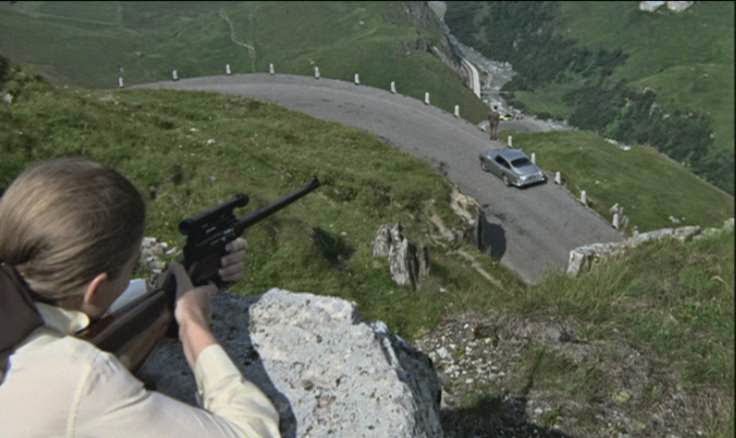
Goldfinger is no exception. It isn't my favorite Bond movie from this decade, but it's definitely the one that set the visual standard for future installations. The foundations of this house style are most apparent in the Switzerland chapter of the film, as demonstrated by Deborah; Ted Moore stuffs his characters into those rolling green hills as often as possible, even mirroring that iconic sniper shot not five minutes after we first see it.


But my favorite shot in Goldfinger employs these principles while at the same time inverting them, stuffing Bond's unconscious body into a cramped space that nonetheless is full of detail:


So many reflective surfaces! So much light! The little gold dots on that stove in the foreground are an especially charming touch. And the way Oddjob's shadow looms dead-center is so menacing. Considering this shot is meant to represent four or five feet of vertical space at most, the composition is unexpectedly busy. Bond occupies little of the frame here, a counterpoint to the equally robust but far more expansive frames he's typically placed in. He's absurdly prone, the first of numerous situations in Goldfinger where he's given the shitty end of the stick and asked to work his way out of bondage/imprisonment/ineffectuality. Perhaps his incompetence in this film is meant to foreshadow his fears of inadequacy in follow-up film Thunderball, expressed through this scene of him ambushed in a highly emasculatory way by recurring terrorist cell SPECTRE:


Nearly naked and being killed by what looks like an out-of-control buttsex machine? The worst possible way to go for a virile superspy. 

Sunday, April 13, 2014

My Ten Favorite Dance Dance Revolution Songs

I was in the throes of a strange adolescence when I fell in love with these songs, and I do not have the musical vocabulary to reason through my choices with anything other than free association and reactionary sentimentality. Proceed with caution.


10) Jenny - Do You Remember Me
Original: Not sure - I read many years ago that this is a cover of a Japanese pop song from the 1970s, but I've since learned that the Internet isn't always a trustworthy place.
First appeared in: DDR MAX (6th Mix)


My friend and I played this at our joint 16th birthday party and my mom told me that I should turn it off or people would start leaving. WHATEVER. For some reason, this song always stuck out amidst the deluge of generic Eurobeat that slammed DDR some time around 5th Mix. It may be Jenny's subtle ESL cadence ("I am gonna g'you a start"???), or that her vocals are tender in a way that the genre rarely manages, or its ridiculously fun Heavy stepcharts, but Do You Remember Me has a lot of personality. I think most people skipped over this song because it was super girly and Dance Dance Revolution is all about looking as cool as possible.

9) Jennifer - If You Were Here
Original: None
First appeared in: 2nd Mix


For better or worse, this song screams DDR. Most people familiar with the game would probably cite smile.dk's Butterfly as the franchise's most notable contribution to popular music, but let's be real - Butterfly is annoying as hell. If You Were Here serves up twice the synthesized Italo Disco goodness with only half of the shrill vocalizations and none of the dubious Orientalism; it's a perfect little encapsulation of the cool-uncool divide that Dance Dance Revolution spent so long trying to navigate. Strange that (if you choose to believe the online whispers of yesterdecade) the opening 13 seconds of this song inspired Naoki Maeda to write MAX 300, the series' first definitive step away from its dance game pretensions.

Tuesday, March 25, 2014

Profiting from the Revolution in 2013

This post contains spoilers for The East, Closed Circuit, and The Fifth Estate. Of the three, only one is actually worth the time, so if you have any intention of watching The East then read at your own risk!


When Occupy Wall Street burst into life on September 17th, 2011, there was a collective hesitation amongst mainstream media outlets to substantially cover the movement. Plenty of coverage on the lack of coverage, sure, but nothing that demanded any investigative clout. Nate Silver estimates that, between approximately four thousand American news outlets, an average of sixteen stories per day were produced about the movement. It wasn't until a certain act of police brutality that major television and print news networks were spurred into action, at least temporarily - viewers may not always show up for stories of protest, but they sure love their institutional violence. Comparatively, social media mentions of Occupy Wall Street totaled at around fifty thousand as quickly as the first day of the movement, a figure that multiplied five-fold after the pepper spray incident and only increased in the following days.

These figures have been echoed by a persistent sentiment in the political discourse of the last two years: there can be no dependence on the systems of old to enact social change, whether those of the government or the media, and the burden of revolution must fall on the common man. The film industry, finger ever on the pulse of popular opinion, has hardly ignored this. Asking audiences to willingly involve themselves in a movie that demands serious systemic introspection, however, is growing increasingly more difficult. Consider the glut of War on Terror films that came out in the mid- to late-2000s, every one of them not named The Hurt Locker failing to make its budget back in America. Domestic film production companies have since been reticent to finance movies about hot issues, perhaps for good reason: The East, Closed Circuit, and The Fifth Estate were all box-office disasters in this vein, "thrillers" cleaving to contemporary questions that simply didn't sell tickets. Conversely, The Dark Knight Rises came out in 2012 spouting almost the exact opposite message, that an impoverished and angry proletariat should wait around for the billionaire heroes of old to bail them out of trouble, and it made 450 million dollars on our shores. Are these the failings of a populace increasingly tethered to escapist entertainment? Can you sneak pro-corporate imperialism into a movie as long as you put a mask or cape on it?

Wednesday, March 5, 2014

The Disappointments of 2013

10) The Canyons 

Blech. This movie is gross and dumb and not fun at all. Paul Schrader owes Stephen Rodrick a fruit basket for that piece in the New York Times. Lindsay Lohan is one of entertainment's most tragic figures, painted in front of hundreds of millions of faces as a child star too weakened by her own vices to function, and Rodrick was wise enough to pour that narrative into a greater piece about failure in the film industry. Schrader, who once wrote with Scorsese, unable to get funding and forced to make micro-budget smut with Lohan and James Deen! It would be easier to feel sympathy for him if he hadn't chosen to film a Bret Easton Ellis script, or if the movie itself wasn't lit like a dive bar and completely lacking in even a single distinctive image. Ellis' script is overwrought hokum, as always, his gallery of drug-addled amoral nudes doing and saying nothing of interest. As for La Lohan herself, it's a bad performance, its marginal trainwreck appeal mostly drowned in mawkish amateurism, but it's fairly low on the list of things wrong with The Canyons. It would probably be easiest to list what's not wrong with it: it has boobs, and Deen's dead sociopath eyes are just right to play his menacing Hollywood wannabe role. And that's it. Any other compliments might cause you to actually watch the film, because admittedly it's quite a curiosity. I would recommend reading Rodrick's article, far more generous to the movie than it deserves, and then never thinking about this sorry black mark on the name of independent cinema again.

Friday, February 28, 2014

My Favorite Films of 2013

10) Computer Chess

Period pieces have an unusual burden. They must present a series of values and customs that are antiquated enough to appeal to an audience's historical curiosity, but they also can't be completely unmoored from contemporary framework, for fear of alienation. In that regard, Computer Chess is an anomaly. Shot on analog video cameras and improvised from an eight-page treatment, the film is formally vexing. Dry as a bone, rhythmically uneven, and laced with complex computer jargon, Andrew Bujalski doesn't transport you to the 80s so much as strand you in it, shooting "actors" on obsolete technology as they interact with obsolete technology. To call this niche would be charitable. But Bujalski's fourth feature is more relevant than its creaky exterior lets on, and once this tournament of competing computer chess programs sneaks in plot threads about a budding romance and a government sponsor, you're suddenly smack in the middle of an allegorical story about the birth of a new technological era. The film's freewheeling structure and casual engagement with genre elements allows it to bounce between the intersection of scientific growth and militarization, the human urge to reject new experiences, and the first inkling of a computer's capacity for intelligence, chillingly rendered through a series of simple messages. And this is to say nothing of the fetus or the prostitute or the army of cats. Difficult to watch, not for everyone, but unique enough to really stick.

Wednesday, December 18, 2013

La residencia (or The House That Screamed): Quasi-Lesbian Fascist Hijinks

This entry comes to you courtesy of Final Girl's December Film Club. Viva Ponder! Spoilers for the whole movie.


Yesterday I was given the opportunity to watch La residencia, a slice of late-60s Spanish-produced horror that has exerted considerable influence on the genre despite its cult status. The film is excellent, calling on antecedents from earlier in the decade such as The Innocents and Psycho; it is a delicate (if not soapier) depiction of the madness that germinates in isolated, sexually repressed minds. Its brutality is minimal but perversely poetic, and although its unconventional structure owes a debt to Hitchcock's earlier masterpiece, writer-director Narciso Ibanez Serrador's invocation of Fascist imagery and methodology gives his work a critical charge all its own. Produced and released during the twilight hours of Francisco Franco's dictatorship, Serrador's flirtation with strategically deployed nipples and incestuous kissing speaks to the crumbling of Spain's heavy cultural censorship, a product of an authoritarian environment quite like La residencia's titular boarding school. The moral is universal, though: save for its noticeably vintage fashions, La residencia is atemporal, and thanks to its spirited English dub and multicultural cast, the movie, although it takes place in France, could ostensibly be staged anywhere.

Thursday, October 31, 2013

The 2013 Horror Digest, Part 3: The Killer Inside Me

I was really busy this week and I only wrote four entries instead of the typical five. I'm sure you are all beside yourselves about it. If you're curious, the omitted film was World War Z, which is probably my favorite blockbuster of the year. Who would have thought?

All the Boys Love Mandy Lane


All the Boys Love Mandy Lane will probably be remembered more for its nightmarish release history than its content, a seven-year cautionary tale that catches Bob Weinstein in one of his more tone-deaf moments. Unshackled from the horror trends of 2006, a year glutted with remakes, sequels, and cheap torture flicks, Mandy Lane was cursed with a negative box office prognosis and bounced from studio to studio until the Weinsteins inexplicably purchased it again in 2013. That the film went on to double its budget in a limited international release may be a result of this sensationalized hype, but wouldn't it be nice if we could shelve the drama and give credit where credit is due? Mandy Lane, directed by the same Jonathan Levine behind this year's Warm Bodies, is a stylish and intelligent teen slasher sensibly rooted in the insecurities of its youthful cast. Mandy Lane (Amber Heard, better here than ever) is a stunning high schooler routinely hounded by boys, one of whom dies trying to impress her. Her enigmatic charm tarnished, she becomes something of a recluse, breaking out of her shell only long enough to attend a remote countryside party with a few acquaintances. As horror dictates, most of these teenagers are raging assholes, but Mandy Lane is sensitive enough not to fully place the blame on them. Their maladaptive behavior is instead shown as an extension of their self-hatred, manifested through body image issues and challenged masculinity; the film at large is a treatise on the corruptive influence of sexuality, and how complex the lives of the young grow when conscious attraction is introduced to them. Levine's emphasis on failed flirtation and body-shaming creates an embarrassed, uncomfortable atmosphere, one that the film only escapes during the moments where the gang forgets their sexual agendas and just has fun. The script is pitched a bit feverishly so as to facilitate the horror elements, which has led to reviews decrying its generic nature, most of them ignorant of the fact that this is a genre film and thus created in service of the aforementioned elements. It would be a different story if the ideas were stale (which they're not, as few teen horrors have such capably explored empathy for their victims) or if the execution was botched (which it wasn't - the movie looks gorgeous and the kills are solid). In their defense, Mandy Lane's greatest failing is that it can't fully reconcile the medium and the message, most noticeable in its clever but wobbly ending. Levine more than acquits himself with excellent craftsmanship, a talented cast, and the best damn soundtrack I've heard from the genre in years. Where else are you going to get a spread like Peaches, Beethoven, "Sister Golden Hair," and this lovely Bobby Vinton cut? Cool in 2006, cool in 2013. B+

Wednesday, October 2, 2013

The 2013 Horror Digest, Part 2: Beasties/Boys

Berberian Sound Studio


Since horror is so dependent on culturally recursive imagery, often scaring us with things that we know we'll be scared of, it proves itself a fertile ground for namechecking, parody, and homage. None of these intrigue me more than the giallo homage. Despite the fact that Italy's wackiest subgenre is characterized by arrhythmic narrative structure, unpredictable editing, and shot after non-sequitur shot, films attempting to pay their dues to such a singular cinematic phenomenon often employ these techniques too academically. Berberian Sound Studio, arriving three years after staid but enjoyable Amer or Dario Argento's God-awful Giallo, mostly manages to avoid this. Toby Jones plays a sensitive introvert who, having only designed sound for nature documentaries, finds that his new overseas gig producing gory sound effects for an Italian horror movie exacts a high emotional and mental toll. This movie has no aspirations toward true giallodom, instead borrowing giallo's delightfully squishy sound design (what do you think that produce is for?) and baroque low-key lighting to grant style to a mostly conventional narrative. Berberian Sound Studio is a far cry from generic shock horror, though, instead a sinister character piece as portrayed masterfully by Jones and facilitated through a series of increasingly oppressive interpersonal encounters. The problems set in during the final fifteen minutes, when the house of cards finally collapses and our protagonist finds himself in a set of alien circumstances that do little to illuminate what we've already seen of him. Far from the Berberian Sound Studio that wet its hands playing in the blood of giallos past, the ending swings wide and fails both in the typical and atypical realms the rest of the movie bounces between. It has its own intrigue if you're into random things (see also The Lords of Salem), but thrust like a knife into a carefully written screenplay, it makes sadly little sense.

Friday, September 13, 2013

A Friday the 13th of Friday the 13ths

Friday the 13th has a well-earned reputation as one of the most venerable horror franchises in history, but despite its formidable box-office success, its entries were mostly derided by critics and treated as slasher movie junk food. That junk-foodiness is so much of the appeal, though: this is a series of incredibly low density, even less than contemporaries Halloween or A Nightmare on Elm Street. They are intellectually disengaged, basally pleasing movies, providing all of the notorious bottom-of-the-barrel thrills that the genre trafficks in. They're always short, always ridiculous, and typically entertaining on at least one level, with some really unfortunate exceptions. Ascending from "fucking dreadful":

Jason Goes to Hell (1993)


This is how Jason Goes to Hell makes me feel. It is pure profiteering garbage, a desperate bid from New Line to wring a few more dollars from Friday the 13th's corpse after acquiring it from Paramount. Not a drop of passion or talent went into crafting this cheap, muddy, incomprehensible mess, a movie that is often so poorly lit that you can't even see who's getting killed or how Jason's doing it. Aside from one technically impressive but overlong scene of a face randomly melting, this is 100% skippable. The theme song is hilarious, though, a sure sign of Harry Manfredini's complete disinterest in the franchise:


Thursday, September 12, 2013

The David Cronenberg Sinister Beauty Parade

David Cronenberg films are led by men almost universally, but nearly every one of them features at least one compelling female role as well. Often these roles are enhanced by his eye for women who are darkly alluring, polished surfaces that give way to warped thoughts (much like the movies themselves). A few I've noticed lately:


Lynn Lowry, Shivers: The prototype, if you will; a blueprint for a newborn artist. Lovingly filmed right in the middle of an expository dialogue about "a parasite that's a combination of aphrodisiac and venereal disease that will hopefully turn the world into one beautiful, mindless orgy." Lowry is a commanding presence in a movie that often finds its time divided amongst a bloated cast, but her lilting, eerie final monologue puts her above and beyond the rest.


Genevieve Bujold, Dead Ringers: Probably a top 5 performance for Cronenberg's oeuvre, Bujold's turn as an over-the-hill actress with a Master's in sexual depravity is both perverted enough to enliven the obsessive, sociopathic Mantle twins (Jeremy Irons, also top 5), and human enough to challenge them. Her face and voice and body leave her unable to deny this intense dysfunctional connection, no matter what words come out of her mouth. 


Judy Davis, Naked Lunch: Small picture, but you get the idea. For a while in the early 90s, Judy Davis was the go-to gal for auteurs looking to cast a cold, vastly intelligent woman. Naked Lunch is convoluted and sort of exhausting, but Cronenberg at least has his gift for prosthetics to give visual life to an inscrutable story, and the good sense to frame it autobiographically by dragging elements of crazy-ass William S. Burroughs' life into the narrative. Davis, despite a limited role, serves as both the catalyst for Peter Weller's delusion and his singular erotic obsession, the remaining vestige of an increasingly foreign life left behind.


Sarah Gadon, A Dangerous Method + Cosmopolis + Maps to the Stars: Cronenberg's newest muse and the only woman with whom he has collaborated repeatedly, Sarah Gadon's conventional beauty exudes more than a fair share of menace. There's an air of inaccessible power to her, something that both Cronenberg (frigid heiress in Cosmopolis, Hollywood matriarch of old in Maps to the Stars) and his son Brandon (Antiviral's celebrity to end all celebrities) have employed with considerable results in the last few years. Her career is young yet, but she's an intelligent woman with excellent taste in auteurs, so the prognosis for a rich filmography is promising.

Saturday, September 7, 2013

The Trouble With Harry


At the peak of his popularity in the mid-2000s, Harry Knowles was making $700,000 a year through his self-proclaimed film nerd sanctuary Ain't it Cool News. No critic from now until the end of time will dream of collecting that sort of cash ever again. This astronomical success is, much more than any virtues of his own, a testament to the inestimable value of being in the right place at the right time. When Knowles founded Ain't it Cool in 1996, there was simply no competition; not even fellow early tech adopter Roger Ebert had the same magnitude of online presence that The King of Filmgeekdom commanded. Studios trembled in his shadow - a Knowles pan spelled certain devastation for a film, and his word is credited with the financial failure of such classics as Batman and Robin and Rollerball.

Here's the rub, though: Harry Knowles is a sexist manchild who, even at the height of his powers, was only able to generate dialogue amongst readers half his age. His "films are awesome!" credo holds its own valuable optimistic appeal, but in Knowles' case the awesomeness of a film is generally correlated to how much the studio heads kiss his ass at the junket before he watches it. Everyone's gotta start somewhere, and I believe that people of dubious principle can mature with time and reflection. But what happens when you don't develop? What happens when those studios you once cowed grow savvy to how easily bought you are, how derelict your journalistic integrity is? What happens if you've been writing the same crass, nonsensical bullshit for the last seventeen years of your life? Feast upon this juicy morsel from his Blade 2 review, all the while remembering that this is how an actual person felt about Blade 2 (NSFW!):

Friday, August 30, 2013

The 2013 Horror Digest, Part 1: I'd Sell My Soul for a Good Opening Weekend

I don't know if you guys have noticed, but 2013 has been pretty good to horror so far! At least to its box office - the quality of this year's offerings have been a mixed platter, typical of any studio slate, but the real revelation is the genre's renewed, almost instantaneous bankability. The Conjuring had one of the highest opening weekends for an R-rated film of all time; the only other R-rated horror film to make so much money so quickly was Paranormal Activity 3. The Purge multiplied its budget by thirty. Evil Dead nearly broke $100 million. And those are just the R-rated flicks alone - World War Z took in major bank overseas, for instance. Mama did well, Dark Skies did well, Warm Bodies did well even though it shouldn't have. Maybe my 2011/2012 prognostications about the future of adult horror were preemptive, or maybe there's been some kind of worldwide attitudinal shift that's gotten mainstream audiences so interested in all this depravity. Could it be a growing notion that our world is falling apart?

There's been a noticeable preoccupation with economic decay in many of the movies released this year, almost certainly a reflection of our nation's dire straits. This isn't a new trend to film, cropping up as early as Great Depression musicals in order to pair common audience anxieties with a gleeful, utopian worldview. To see these fears interlaced with the horror genre, however, is particularly exceptional. Three of the films below deal with financial crises, at least in passing, and the other two feature protagonists overcoming major drug addictions. The prevalence of such heavy subject matter in a genre with few escapist tendencies is strange, but as with any regularly employed cultural trend, its incorporation is livened or worsened by the skill of its creative team. The movies below, for the most part, depict these issues thoughtfully enough to merit their inclusion. Except for Evil Dead. Fuck that shit.

Antiviral [Netflix]


You would have to be a lunatic to desire fame in the 21st century. Paparazzi may seem intrusive enough as it is, but images of an otherwise average person going about her routine don't cut it anymore. Social technologies like Twitter have entitled millions of people to a feeling of constant connectivity to their idols; such an increased degree of exposure is a double-edged sword, because now any teenage shitheel can anonymously slander or threaten you whenever his shriveled heart desires. The Internet has left us all living in public, but to many, the life of a celebrity is hardly a life at all. Antiviral ups the ante on these already sad circumstances by depicting a near future where celebrity culture is the only kind of culture, a world in which the ultimate expression of adoration is paying hand-over-fist to be injected with the viruses of these beautiful people. These "celebrities" don't even sing or act, simply serving as proprietary pathogenic vessels for corporations to make money off the unwitting. Huckster Syd March (Caleb Landry-Jones of X-Men First Class, deliciously cold) peddles these germs for the omnipotent Lucas Clinic, but unsurprisingly the big guys aren't paying their workers too much in times like these, so occasionally he'll steal viruses and sell them on the black market. Unfortunately, Syd never accounted for this society's insidious idea of copyright protection, and so begins his great adventure. Brandon Cronenberg, inspired by an offhand remark in a Sarah Michelle Gellar interview, has created a world in the image of his father's work that is populated by obsessions entirely his own. This fame-forged dystopia is brimming with hardship, but its citizens are too doped up on entertainment to understand what a hard life entails except by relating to celebrity "Ordeals," manufactured traumas like having a camera zoom up your rectum (broadcast on the news as, of course, the Aria Noble Anus Ordeal). Beautifully shot and conceived, Antiviral nonetheless betrays its director's inexperienced hand, as the clever concepts and shifts in understanding are occasionally explained more closely than they need to be. Nonetheless, Cronenberg delivers a portrait of manic devotion that is not only contemporary (Miley, One Direction, Lady Gaga, et al.), but indicative of a society suffering a much greater structural disease than any one human might carry. B+

Wednesday, August 14, 2013

Elysium, Technocracy, and a Curious Case of "Heavy-Handedness"


Minor spoilers follow.

Elysium, the sophomore effort of South African writer-director Neill Blomkamp, continues a tradition of socially conscious action film established by his previous critical darling District 9. Moving away from D9's apartheid allegory into questions of class and privilege in the year 2154, Blomkamp can't be faulted for his ambition: how many blockbuster filmmakers are this invested in delivering a product with a substantial message? Most critics haven't seen it so reasonably, and although the response to the film has been one of lukewarm enthusiasm, many of its champions qualify it as well-made action (and it really is!) that is "hazy" and "on-the-nose" while detractors write it off as having a substantial base for an insubstantial result, as if one of the goals of an action film should not be to provide action. There's a vocal dissatisfaction with the movie's supposed unsubtlety in mirroring the American healthcare system, which is perhaps a result of critics' zeal to prove their understanding, but the multiple subterranean issues of technological superiority that inform the whole movie are completely ignored. Without understanding the face of a world shaped by technology's ubiquitous hand, Elysium might seem "hazy" or "blank," but Blomkamp demonstrates a sophisticated (if unevenly expressed) understanding of the forces that guide our economic and cultural development in an increasingly unstable time.

Tuesday, July 30, 2013

Fear is Fascinating: Clock Tower and the Gnarled Evolution of Survival Horror


A work of horror art most always calls upon a collection of familiar, archetypal anxieties, sculpted into worst-case scenarios with sinister faces. Cabin in the Woods says it best when it labels its retinue of monsters as "remnant of the Old World," all of them nightmare visions continually filtered through the collective conscious. The ingredients remain the same; the alchemy is volatile, subordinate to the aesthetic and cultural trends of the time, the artist's command of his or her subject, and perhaps most critically, the medium in which it is presented. Video games have had an exceptionally difficult time nailing down the formula for a variety of reasons that only seems to multiply as their technology develops.

Horror in gaming is often described as "survival horror" because, well, it falls on You the Player to survive. Easier said than done when the games of this genre deliberately leave you understocked and unprepared for whatever threats are waiting to bury you. Combat and restorative items are either nonexistent or in short supply, an emphasis is placed on spatial awareness and puzzle solving, and danger lurks unrepentant at every turn. These design principles can be found in games as early as the NES's 1989 Sweet Home, a tale of madness and infanticide Nintendo found too gruesome for their delicate American players, and were popularized by Capcom's 1996 Playstation hit Resident Evil. The problem is that the ludic cornerstones of the genre - deprivation, helplessness, resource conservation - run counter to what a vast majority of contemporary gamers now find satisfying in their virtual experience, and as such survival horror has significantly dwindled in popularity. There have been a few attempts to resurrect it, such as breakout hit Amnesia: The Dark Descent, but recent entries in old-guard franchises Resident Evil and Silent Hill have been met with disdain or disinterest.

Sunday, July 14, 2013

Sharknado and Pacific Rim: 21st Century Living for Monsters


Sharknado, SyFy's newest media Hail Mary, premiered on Thursday to squarely average ratings and a deluge of Twitter lurkers desperate for attention. I've already touched on the caveats of intentional camp programming, and this soulless nonsense doesn't deserve many more words than that. Bad movies are typically funny if they're unexpected and unintentional; when you have studios like The Asylum churning out mirror-image screenplays differentiated only by beastie, the thrill of discovery is gone. All you're watching is a movie that has successfully managed to be bad, a workmanlike mimicry of incompetence that begs for ridicule at every turn. Laugh at the man cutting an airborne shark in half with a chainsaw! Mock the newscaster's awkward voice! Groan at "We're gonna need a bigger chopper," just to show your friends that you understand the reference! Sharknado and its ilk are films forged in pure cynicism, the antithesis of what makes a work of art into camp.

Thursday, May 30, 2013

Top of the Lake: A Devil's Heart


Top of the Lake is a mystery, in case you couldn't tell by that picture of Elisabeth Moss peering at some foul secret or something through the trees. Not that "mystery" tells us much anymore about narrative art, since any plot line by nature must have some mysterious elements in order to keep it compelling, but typically we associate it with a crime, suspects, motives, alibis...the whole collection of modular pieces that suit the needs of its storyteller's message. All of these elements are necessarily in service to unraveling or shading the central mystery, though a skilled craftsman can distract from this mechanical approach. Jane Campion's deft creative hand guarantees that Top of the Lake – equal parts rape-murder riddle, gender polemic, socioeconomic dissection, and character study – wobbles only minimally, despite the wealth of content on hand. A densely plotted six-hour miniseries brings outstanding attention to its swerves in storytelling, especially when they're as portentous as a bottle labeled “ROOFIES” or as inexplicable as a character being pardoned almost immediately for stabbing someone in a bar. Though consistently compelling, Top of the Lake is also noticeably sloppy, which ultimately diminishes the genre framework that Campion chooses to work in.

Tuesday, May 7, 2013

Deadly Premonition, Mass Effect 3, Bioshock Infinite: Three Choices, No Choice?


Bioshock Infinite, Ken Levine's newest stab at bringing some life to the AAA gaming landscape, has spent the last month enjoying impressive critical and public acclaim. As a game, it is a machine as well-oiled as you could hope to ask for, a first-person shooter etched from thoughtful gun combat and a Vigor system that complements it stylistically and ludically in equal portions. There has been some streamlining, but we're in a gaming climate that streamlines as a matter of course, especially by a franchise's third iteration. Narratively, Infinite hosts a plague of discontents, ameliorated partially by the game's insistence on exploring them through the story's subtext. To simplify drastically, Levine claims through Infinite that narrative video gaming will always be subject to a series of technological restrictions. It's a wonderful idea for a game to grapple with, but it doesn't always work out. Leigh Alexander has done an excellent job at delineating some of the friction that Infinite encounters as a narrative-based game, but some of her arguments are predicated on the notion that the original Bioshock unified narrative and gameplay seamlessly. It is unrealistic to expect every act of brutality in a game of this genre to maintain a sense of commodified mortality; for all that atmosphere and all those piquant Objectivist flourishes and all the hullabaloo about “Would you kindly?”, the first iteration is still a game where you mow down underwater zombies in the hundreds. 

Friday, April 19, 2013

Egress from the Winter 2013 Graveyard, or Finally Some Interesting Movies Come Out


Spring Breakers
Try as you might to disassociate yourself from the parts of Spring Breakers that have already entered our cultural consciousness - Disney bikini ass boobs murder gun fellatio piano James Franco??? - there's really not much else to the movie, so you kind of have to accept its lack of substance out of the gate. It is almost totally repetitive, probably a deliberate decision when you take Harmony Korine's enfant terrible status into consideration, but there's a method to this droning madness. Korine's subjects are four girls who flee college toward this soulless liturgy of party-party-party-party-party, under the pretense of "finding themselves" and "changing their boring lives." That this is achieved through scene after scene of constant drinking and carnage, all set to a Skrillex soundtrack, is a fairly transparent irony. But Spring Breakers has a sneaky streak, realized primarily through the fates of these young women. These supposed heroines are delinquents in training, securing their travel funds by robbing a Chicken Shack with sick ferocity. They knowingly exert seductive power over local crime lord/hip-hop demicelebrity Alien, played by James Franco with a degree of conviction that suggests actual interest in this project. And if Franco is involved and intrigued, you can only imagine what kind of raunchy, dopey, entry-level Social Welfare 101 nonsense this unholy alliance will birth. He and his cohort stumble through a series of bizarre events, all linked by the connective tissue of booze and tits on the beach of St. Petersburg and all ending in totally unexpected ways. When the end finally arrives, seemingly half an hour too late, he and the girls splinter from each other in unexpected ways in a climax designed for neither a vindictive nor a sympathetic audience. Selves are found, lives are changed, but these inevitabilities are livened by the details. Harmony Korine's message may be somewhat obvious, but his delivery is not, and the thumping machine that is Spring Breakers chugs on regardless of what anyone thinks of or expects from it. B-